Decentralized Computing 2026: The U.S. Tech Revolution

Beyond the Cloud: Understanding the 2026 Shift to Decentralized Computing in the U.S.
The technological landscape is in a constant state of evolution, and few shifts promise to be as transformative as the impending move towards decentralized computing 2026 in the United States. For years, cloud computing has dominated the digital infrastructure, offering unprecedented scalability and accessibility. However, as data volumes explode, latency becomes a critical concern, and the demand for enhanced security and privacy intensifies, the limitations of centralized cloud models are becoming increasingly apparent. The year 2026 is poised to mark a significant inflection point, ushering in an era where computational power, data storage, and network intelligence are distributed across a vast, interconnected network of devices and nodes.
This article will delve deep into what this shift entails, why it’s happening now, and the profound implications it holds for businesses, individuals, and the broader U.S. economy. We’ll explore the underlying technologies driving this transition, the challenges that need to be overcome, and the incredible opportunities that lie ahead as we embrace a more resilient, efficient, and user-centric digital future.
The Genesis of Decentralization: Why Now?
The concept of decentralized computing isn’t entirely new, but several converging factors are accelerating its adoption, making decentralized computing 2026 a realistic and necessary goal. The exponential growth of the Internet of Things (IoT), with billions of devices generating vast amounts of data at the ‘edge’ of the network, is a primary driver. Processing all this data in centralized cloud data centers introduces significant latency, making real-time applications like autonomous vehicles, smart city infrastructure, and remote surgery impractical.
Furthermore, concerns around data privacy and security have reached an all-time high. Centralized data repositories are attractive targets for cyberattacks, and the sheer volume of personal and sensitive information stored in the cloud has raised questions about control and ownership. Decentralized models, particularly those leveraging blockchain technology, offer a more secure and transparent alternative, distributing data across multiple nodes and employing cryptographic techniques to ensure integrity and immutability.
The increasing demand for resilient and fault-tolerant systems also plays a crucial role. A single point of failure in a centralized cloud can bring down vast swathes of services. Decentralized networks, by their very nature, are designed to be more robust, with no single entity controlling the entire system. If one node fails, others can pick up the slack, ensuring continuous operation.
Defining Decentralized Computing: Beyond the Buzzwords
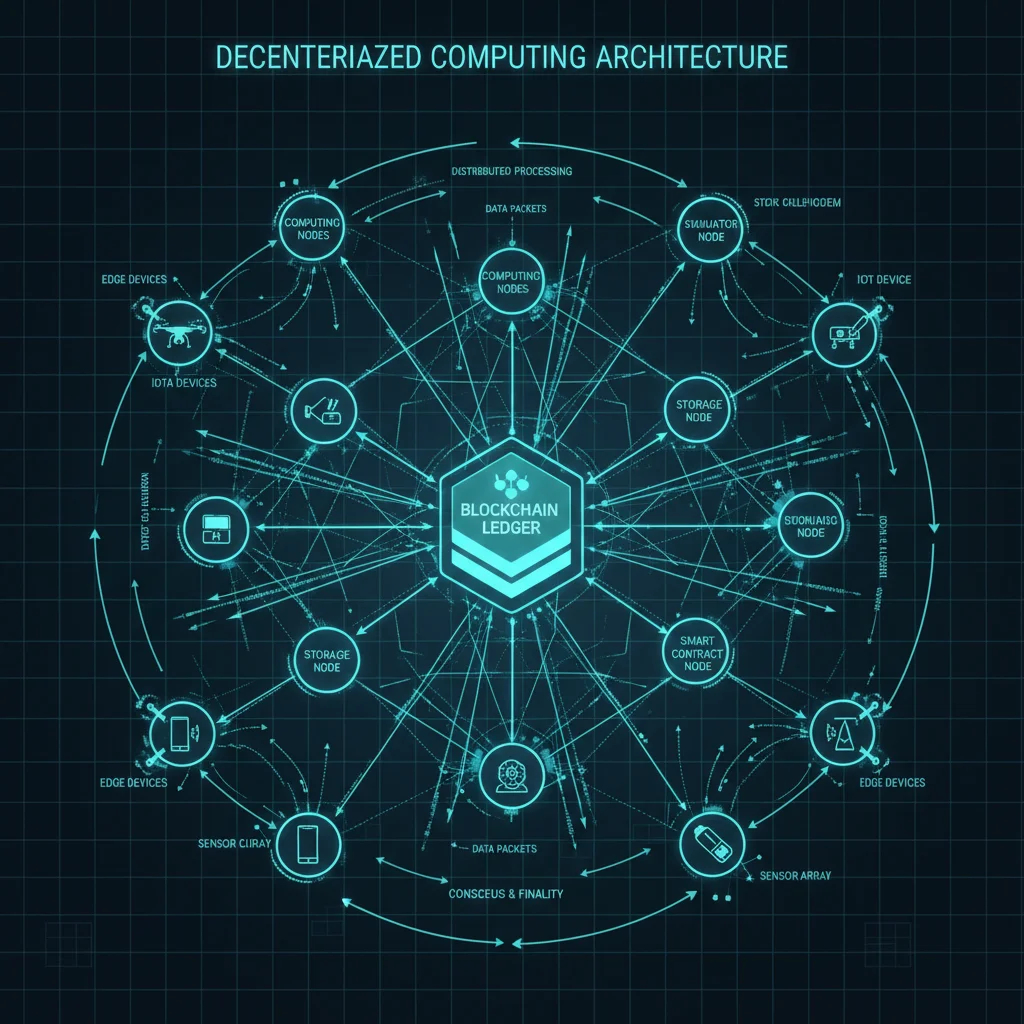
To truly understand the shift to decentralized computing 2026, it’s essential to clarify what it actually means. At its core, decentralized computing refers to a system where computing resources, data storage, and processing are distributed across a network of individual nodes, rather than being concentrated in a single central server or data center. This stands in stark contrast to traditional centralized cloud computing, where a few large providers manage vast data centers that serve the entire network.
Key Pillars of Decentralized Computing:
- Edge Computing: This involves processing data closer to its source, at the ‘edge’ of the network, rather than sending it all the way to a centralized cloud. This significantly reduces latency and bandwidth usage, crucial for real-time applications.
- Distributed Ledger Technologies (DLT) / Blockchain: Blockchain provides a secure, immutable, and transparent way to record transactions and data across a network of computers. It forms the backbone for trust and data integrity in many decentralized systems.
- Peer-to-Peer (P2P) Networks: These networks allow participants to directly share resources and data without the need for a central server. File sharing platforms like BitTorrent are classic examples, but P2P is evolving to support more complex computational tasks.
- Fog Computing: Often seen as an extension of edge computing, fog computing acts as an intermediary layer between edge devices and the cloud, providing localized computing, storage, and networking capabilities.
- Serverless Computing (in a decentralized context): While serverless can exist in centralized clouds, its principles of abstracting infrastructure and paying only for execution align well with decentralized models, where tasks are executed on available distributed resources.
These technologies aren’t mutually exclusive; rather, they often work in concert to create robust and efficient decentralized ecosystems. The synergy between them is what makes the decentralized computing 2026 vision so powerful.
The Impact on Businesses: A New Paradigm for Operations
The transition to decentralized computing 2026 will necessitate a significant rethinking of business operations across nearly every industry. Companies will need to adapt their IT strategies, data management practices, and even their business models to leverage the advantages of this new paradigm.
For Enterprises:
- Enhanced Data Security and Privacy: By distributing data and leveraging cryptographic techniques, businesses can reduce their attack surface and enhance data sovereignty. This is particularly critical for industries handling sensitive customer data or intellectual property.
- Reduced Latency for Critical Applications: Industries like manufacturing (Industry 4.0), healthcare (telemedicine, remote diagnostics), and transportation (autonomous vehicles) will benefit immensely from real-time data processing at the edge, enabling faster decision-making and improved operational efficiency.
- Operational Resilience: Decentralized architectures offer greater fault tolerance. Should one part of the network experience an outage, other nodes can continue to function, ensuring business continuity.
- Cost Optimization: While initial investment might be required, long-term operational costs could decrease by reducing reliance on expensive centralized cloud infrastructure and optimizing bandwidth usage.
- New Business Models: Decentralized platforms can enable new forms of collaboration, resource sharing, and even create tokenized economies within specific business ecosystems.
Challenges for Businesses:
- Interoperability and Standardization: A fragmented landscape of decentralized technologies could pose integration challenges. Industry-wide standards will be crucial.
- Management and Orchestration: Managing a highly distributed infrastructure can be complex, requiring new tools and skill sets.
- Security Complexity: While decentralized systems can enhance security, they also introduce new security considerations, such as securing individual nodes and managing distributed identities.
- Regulatory Compliance: Navigating a complex regulatory landscape, especially concerning data residency and privacy across distributed nodes, will be a significant hurdle.
The Individual’s Perspective: More Control, New Experiences
For the average individual, the shift to decentralized computing 2026 might not be immediately apparent in the same way a new smartphone model is. However, its effects will subtly, yet profoundly, reshape our digital lives, offering greater control and enabling entirely new experiences.
Benefits for Individuals:
- Enhanced Data Privacy and Ownership: Decentralized identity solutions and data storage can give individuals more control over their personal information, choosing what to share, with whom, and for how long. This moves away from the current model where tech giants often control vast amounts of personal data.
- Faster, More Responsive Applications: Edge computing will lead to a noticeable reduction in lag for applications that demand real-time interaction, from gaming and augmented reality to smart home devices.
- Increased Digital Resilience: Less reliance on single points of failure means fewer widespread outages affecting our daily digital services.
- New Economic Opportunities: Decentralized platforms can facilitate peer-to-peer economies, allowing individuals to monetize their unused computing resources or data in new ways.
- Censorship Resistance: Decentralized networks are inherently more resistant to censorship, as there’s no central authority to block or control information flow.
Potential Downsides for Individuals:
- Increased Responsibility: With greater control comes greater responsibility. Managing decentralized identities and securing personal nodes might require a higher degree of technical literacy.
- Complexity: The initial learning curve for interacting with some decentralized applications and systems could be steeper.
- Scalability Concerns (early stages): While improving, some decentralized networks still face scalability challenges compared to highly optimized centralized clouds.
- Fragmented User Experience: Until standards mature, users might encounter a less unified experience across different decentralized platforms.
Key Technologies Driving the 2026 Shift
The vision of decentralized computing 2026 is not a distant dream; it’s being built upon a foundation of rapidly maturing technologies. Understanding these components is crucial for grasping the scope of the transformation.
Blockchain and Distributed Ledgers:
Beyond cryptocurrencies, blockchain’s core utility lies in creating immutable, transparent, and secure records. In decentralized computing, blockchain can be used for:
- Supply Chain Management: Tracking goods and ensuring provenance without a central intermediary.
- Digital Identity: Self-sovereign identity solutions where users control their digital credentials.
- Data Integrity: Ensuring the authenticity and tamper-proof nature of data across distributed systems.
- Resource Allocation: Managing and auditing the use of distributed computing resources.
Edge and Fog Computing:
These are critical for bringing computation closer to the data source. Imagine:
- Smart Factories: Real-time analysis of sensor data on the factory floor to optimize production and predict maintenance needs, without sending all data to the cloud.
- Autonomous Vehicles: Instantaneous processing of environmental data for navigation and safety, where milliseconds matter.
- Smart Cities: Managing traffic flow, public safety, and utility usage with localized intelligence.
Artificial Intelligence and Machine Learning (AI/ML) at the Edge:
The power of AI is maximized when it can act on data immediately. Decentralized computing enables:
- Federated Learning: Training AI models on decentralized datasets without the data ever leaving its source, enhancing privacy and security.
- Real-time AI Inference: Deploying AI models directly on edge devices for instant decision-making, such as facial recognition at a security checkpoint or predictive maintenance in machinery.
Web3 and Decentralized Applications (dApps):
Web3 represents the next iteration of the internet, built on decentralized principles. dApps are applications that run on a decentralized network, often leveraging blockchain for their backend. This allows for:
- Decentralized Social Media: Platforms where users have more control over their content and data.
- Decentralized Finance (DeFi): Financial services operating without traditional intermediaries.
- Decentralized Storage: Storing data across a network of computers, making it more resilient and often more cost-effective.
The Road Ahead: Challenges and Opportunities for the U.S.
The U.S. is uniquely positioned to lead the charge in decentralized computing 2026, given its robust technological infrastructure, innovative spirit, and strong venture capital ecosystem. However, realizing this vision will require concerted effort to overcome several significant hurdles.
Key Challenges:
- Regulatory Frameworks: Existing regulations designed for centralized systems may not adequately address the complexities of decentralized networks, particularly concerning data governance, jurisdiction, and liability. Crafting forward-thinking policies will be crucial.
- Interoperability Standards: For decentralized systems to truly flourish, different platforms and protocols must be able to communicate seamlessly. Establishing industry-wide standards will be a monumental task.
- Security and Trust: While decentralization can enhance security, it also introduces new attack vectors. Ensuring the security of individual nodes and the overall network integrity will require continuous innovation and robust best practices.
- Scalability: Many decentralized technologies, especially blockchain, still face scalability challenges when dealing with high transaction volumes. Ongoing research and development are vital to overcome these limitations.
- Talent Gap: The demand for skilled professionals in areas like blockchain development, distributed systems architecture, and edge AI will surge, necessitating significant investment in education and training.
- Consumer Adoption: For decentralized technologies to achieve widespread success, they must offer a user experience that is as intuitive, if not more so, than their centralized counterparts.
Opportunities for the U.S.:
- Economic Leadership: By pioneering decentralized computing, the U.S. can solidify its position as a global leader in technological innovation, fostering new industries and job creation.
- Enhanced National Security: Decentralized infrastructure can provide a more resilient and secure foundation for critical national infrastructure, reducing vulnerabilities to cyberattacks.
- Innovation Ecosystem: The shift will spur innovation in hardware, software, and services, creating a vibrant ecosystem of startups and established tech companies.
- Data Sovereignty and Privacy: The U.S. can set global standards for data privacy and individual control, leveraging decentralized models to empower citizens.
- Global Influence: By developing robust and ethical decentralized systems, the U.S. can influence global norms and standards for the future of the internet.

The Role of Government and Industry Collaboration
The successful transition to decentralized computing 2026 will not happen in a vacuum. It requires a collaborative effort between government, industry, academia, and civil society. Government bodies will play a crucial role in:
- Funding Research and Development: Investing in foundational research for decentralized technologies.
- Developing Clear Regulatory Frameworks: Creating a predictable and supportive legal environment that encourages innovation while protecting consumers and national interests.
- Promoting Standards: Facilitating the development and adoption of interoperability standards.
- Cybersecurity Initiatives: Supporting efforts to secure decentralized networks and educate the public on best practices.
Industry leaders, in turn, must drive innovation, build practical applications, and collaborate on open-source projects. Academia will be vital in training the next generation of engineers and researchers. Civil society organizations can advocate for user rights and ensure that decentralized technologies are developed ethically and inclusively.
Preparing for the Decentralized Future
As 2026 approaches, businesses and individuals alike should begin preparing for this transformative shift. For businesses, this means:
- Assessing Current Infrastructure: Evaluate how existing systems can adapt to or integrate with decentralized components.
- Investing in Talent: Train current employees and recruit new talent with expertise in blockchain, edge computing, and distributed systems.
- Exploring Pilot Projects: Start small with specific use cases to understand the benefits and challenges of decentralized solutions.
- Engaging with Industry Groups: Participate in forums and consortia that are shaping the future of decentralized computing.
For individuals, preparation involves:
- Learning the Basics: Understand the fundamental concepts of blockchain, decentralized applications, and data privacy.
- Exploring New Platforms: Experiment with decentralized social media, financial tools, and storage solutions.
- Prioritizing Digital Literacy: Develop skills to manage personal data and digital identities in a more distributed environment.
Conclusion: Embracing the Decentralized Horizon
The year 2026 is not just another date on the calendar; it represents a pivotal moment in the evolution of technology, particularly for the U.S. The shift to decentralized computing 2026 promises a future where our digital infrastructure is more resilient, secure, efficient, and user-centric. While the journey will undoubtedly present its share of challenges, the opportunities for innovation, economic growth, and enhanced individual empowerment are immense.
Embracing this decentralized horizon means moving beyond the familiar confines of centralized cloud models and venturing into a distributed landscape where intelligence and power reside closer to the source. It’s a future that demands foresight, collaboration, and a willingness to reimagine how we interact with technology and each other. The U.S. has the potential to lead this charge, shaping a digital world that is not only more advanced but also more equitable and robust for everyone.