AI Ethics Frameworks: US Compliance & Trust by 2026
5 AI Ethics Frameworks U.S. Companies Must Implement by 2026 for Compliance and Trust
The rapid advancement of Artificial Intelligence (AI) has ushered in an era of unprecedented innovation, transforming industries and reshaping our daily lives. However, this technological revolution is not without its complexities. As AI systems become more sophisticated and deeply integrated into critical sectors, the spotlight intensifies on the ethical implications of their design, deployment, and impact. For U.S. companies, the urgency to address these concerns is paramount, especially with a looming deadline: by 2026, robust AI Ethics Frameworks will not just be a ‘nice-to-have’ but a fundamental requirement for compliance and fostering public trust.
The landscape of AI regulation is evolving swiftly. While a single, overarching federal law on AI ethics in the U.S. has yet to fully materialize, a patchwork of executive orders, proposed legislation, and industry-specific guidelines is forming a clear trajectory. Companies that fail to proactively embed ethical considerations into their AI strategies risk not only severe legal and financial penalties but also irreparable damage to their reputation and customer loyalty. This article delves into five essential AI Ethics Frameworks that U.S. companies must actively implement to navigate this new era successfully.
Understanding and integrating these frameworks is not merely about ticking boxes; it’s about building a sustainable future where AI serves humanity responsibly, equitably, and transparently. From ensuring fairness in algorithmic decision-making to protecting user privacy and establishing clear accountability mechanisms, these principles form the bedrock of trustworthy AI. Let’s explore how businesses can prepare for this pivotal shift and secure their position as leaders in responsible AI innovation.
The Imperative for AI Ethics: Why Now?
The call for ethical AI is growing louder and more insistent. Incidents of algorithmic bias, privacy breaches, and opaque decision-making have highlighted the potential for AI to cause harm if not carefully governed. From discriminatory lending algorithms to facial recognition systems with accuracy disparities, the real-world consequences are tangible and often disproportionately affect vulnerable populations. These challenges underscore the critical need for comprehensive AI Ethics Frameworks.
Evolving Regulatory Landscape
In the U.S., while comprehensive federal legislation is still under development, significant steps have been taken. The Biden Administration’s Executive Order on the Safe, Secure, and Trustworthy Development and Use of Artificial Intelligence (October 2023) signals a clear intent to establish robust AI governance. This order mandates federal agencies to develop standards, guidelines, and best practices for AI safety and security, directly influencing the private sector. Furthermore, state-level initiatives, such as those in California and New York, are beginning to address specific AI applications, creating a complex web of compliance requirements.
Internationally, frameworks like the EU’s AI Act are setting a global precedent, influencing how U.S. companies operating globally must approach AI ethics. The convergence of these regulatory pressures means that waiting for a definitive federal mandate is a risky strategy. Proactive adoption of AI Ethics Frameworks allows companies to shape their practices in anticipation of future regulations, rather than scrambling to react.
Building and Maintaining Public Trust
Beyond compliance, trust is the ultimate currency in the digital age. Consumers, employees, and stakeholders are increasingly aware of AI’s power and potential pitfalls. Companies perceived as irresponsible or unethical in their AI deployment face significant reputational damage, customer churn, and difficulty attracting top talent. Conversely, those that demonstrate a commitment to ethical AI can differentiate themselves, build stronger brand loyalty, and foster a positive public image.
A strong AI Ethics Framework signals to the world that a company takes its responsibilities seriously. It demonstrates a commitment to values beyond profit, such as fairness, transparency, and human well-being. This proactive stance is crucial for long-term success and sustainability in an AI-driven economy.
The 5 Essential AI Ethics Frameworks for U.S. Companies
1. NIST AI Risk Management Framework (AI RMF)
The National Institute of Standards and Technology (NIST) released its AI Risk Management Framework (AI RMF 1.0) in January 2023, providing a voluntary framework to manage risks associated with AI systems. While voluntary, its comprehensive nature and alignment with global best practices make it a de facto standard that U.S. companies should embrace. The AI RMF is designed to be adaptable across various sectors and AI applications.
The framework is structured around four core functions: Govern, Map, Measure, and Manage.
- Govern: This function emphasizes establishing a culture of risk management, clear policies, and procedures for AI development and deployment. It involves defining roles, responsibilities, and accountability mechanisms within an organization. For instance, establishing an AI ethics committee or assigning a Chief AI Ethics Officer would fall under this category.
- Map: Identifying and understanding the context, risks, and impacts of an AI system throughout its lifecycle. This includes mapping potential biases in data, identifying privacy risks, and understanding the societal implications of the AI’s output.
- Measure: Quantifying, evaluating, and tracking AI risks. This involves developing metrics and methodologies to assess fairness, accuracy, robustness, and other ethical considerations. For example, regularly auditing algorithms for bias or monitoring system performance post-deployment.
- Manage: Prioritizing, responding to, and recovering from AI risks. This includes implementing mitigation strategies, developing incident response plans, and continuously improving AI systems based on risk assessments.
Implementing the NIST AI RMF allows companies to systematically identify, assess, and mitigate AI-related risks, ensuring their systems are developed and used responsibly. It provides a structured approach to embedding ethical considerations from conception to decommissioning.
2. Principles of Fairness, Accountability, and Transparency (FAT/ML)
The principles of Fairness, Accountability, and Transparency (often abbreviated as FAT or FAT/ML, with ML for Machine Learning) are foundational to ethical AI and have emerged from academic research and advocacy groups. They are universally recognized as critical components of responsible AI development.
- Fairness: This principle demands that AI systems treat all individuals and groups equitably, avoiding discriminatory outcomes. This means actively identifying and mitigating biases in training data, algorithms, and models that could lead to unfair decisions regarding employment, credit, healthcare, or criminal justice. Companies must consider various definitions of fairness (e.g., demographic parity, equalized odds) and choose appropriate metrics for their specific applications.
- Accountability: This refers to the ability to identify who is responsible for the outcomes of an AI system, especially when errors or harms occur. It requires clear lines of responsibility, robust governance structures, and mechanisms for redress. Companies must establish clear processes for internal oversight, external audits, and user feedback to ensure accountability.
- Transparency: This principle advocates for openness about how AI systems work, their purpose, limitations, and potential impacts. This doesn’t necessarily mean revealing proprietary code but rather providing sufficient explanation for stakeholders to understand the AI’s behavior. This includes documenting data sources, model architectures, decision-making processes, and performance metrics. Explainable AI (XAI) techniques are crucial here.
Integrating FAT principles involves a continuous process of auditing, testing, and refining AI systems. Companies should invest in tools and expertise to assess and enhance fairness, establish clear accountability structures, and commit to transparent communication about their AI initiatives.

3. Data Privacy and Security by Design
At the heart of many AI systems lies vast amounts of data, often personal and sensitive. Therefore, robust data privacy and security measures are not just legal requirements (e.g., CCPA, HIPAA) but fundamental ethical obligations for any company deploying AI. The concept of ‘Privacy by Design’ (PbD) and ‘Security by Design’ must be integral to every stage of AI development.
- Privacy by Design: This approach mandates that privacy considerations are embedded into the design and operation of information systems, often before data collection even begins. For AI, this means minimizing data collection, anonymizing or pseudonymizing data where possible, ensuring purpose limitation, and implementing strong access controls. It also involves obtaining informed consent from users for data usage.
- Security by Design: This principle ensures that security measures are built into the architecture of AI systems from the ground up, rather than being added as an afterthought. This includes robust encryption, secure data storage, protection against adversarial attacks on AI models, and regular security audits. Safeguarding AI models from manipulation and data from breaches is paramount.
Implementing Data Privacy and Security by Design requires cross-functional collaboration between AI developers, data scientists, legal teams, and cybersecurity experts. Companies should conduct thorough Data Protection Impact Assessments (DPIAs) and Privacy Impact Assessments (PIAs) for all AI projects, ensuring that ethical data handling is a core component of their AI Ethics Frameworks.
4. Human Oversight and Control
While AI offers incredible capabilities, it’s crucial to remember that these systems are tools created and operated by humans. The principle of human oversight and control ensures that AI systems augment human capabilities rather than replace human judgment entirely, especially in high-stakes decisions. This framework emphasizes maintaining a ‘human-in-the-loop’ or ‘human-on-the-loop’ approach.
- Human-in-the-Loop (HITL): This involves human intervention at critical junctures of an AI’s decision-making process. For example, an AI might flag suspicious transactions, but a human analyst makes the final decision to block an account. HITL is essential where decisions have significant ethical, legal, or safety implications.
- Human-on-the-Loop (HOTL): Here, humans monitor the AI system’s performance and intervene only when necessary, such as when the AI deviates from expected behavior or performs poorly. This is common in autonomous systems where real-time human intervention isn’t always feasible but oversight is crucial.
- Clear Escalation Paths: Companies must define clear procedures for when human intervention is required, who is responsible for making those decisions, and how those decisions are documented. This includes mechanisms for challenging AI decisions and ensuring avenues for human review and override.
Embedding human oversight requires careful design of AI interfaces, training for human operators, and continuous evaluation of the human-AI interaction. It’s about finding the right balance between AI autonomy and human accountability to ensure ethical outcomes.
5. Social and Environmental Impact Assessment
The deployment of AI systems can have far-reaching societal and environmental consequences that extend beyond immediate user interactions. A comprehensive AI Ethics Framework must include mechanisms to assess and mitigate these broader impacts, demonstrating a commitment to corporate social responsibility.
- Societal Impact: This involves evaluating how an AI system might affect employment (job displacement), social equity, democratic processes (disinformation), accessibility for people with disabilities, and overall human well-being. For example, a company developing AI for recruitment should consider its potential impact on workforce diversity and inclusion.
- Environmental Impact: The training and operation of large AI models consume significant energy, contributing to carbon emissions. Companies should assess the carbon footprint of their AI infrastructure, explore energy-efficient algorithms, and consider the environmental implications of their AI solutions (e.g., optimizing supply chains for sustainability).
- Stakeholder Engagement: Actively engaging with diverse stakeholders, including affected communities, advocacy groups, and domain experts, is crucial for understanding potential impacts and co-creating solutions. This ensures that a wide range of perspectives informs the ethical development and deployment of AI.
Conducting regular Social and Environmental Impact Assessments (SEIAs) for AI projects allows companies to proactively identify potential negative externalities and develop strategies to mitigate them. This proactive approach not only aligns with ethical principles but also strengthens a company’s standing as a responsible corporate citizen.
Implementing AI Ethics Frameworks: A Roadmap to 2026
The journey to full compliance and trustworthy AI by 2026 requires a strategic, multi-faceted approach. Implementing these AI Ethics Frameworks is not a one-time project but an ongoing commitment to responsible innovation.
Step 1: Establish a Dedicated AI Ethics Governance Body
Form an interdisciplinary AI ethics committee or task force comprising representatives from legal, engineering, data science, product development, HR, and ethics departments. This body will be responsible for setting internal policies, overseeing implementation, and acting as a central point for ethical review and decision-making. Assigning clear roles and responsibilities, perhaps even a dedicated Chief AI Ethics Officer, is crucial.
Step 2: Develop and Document Internal AI Ethics Policies
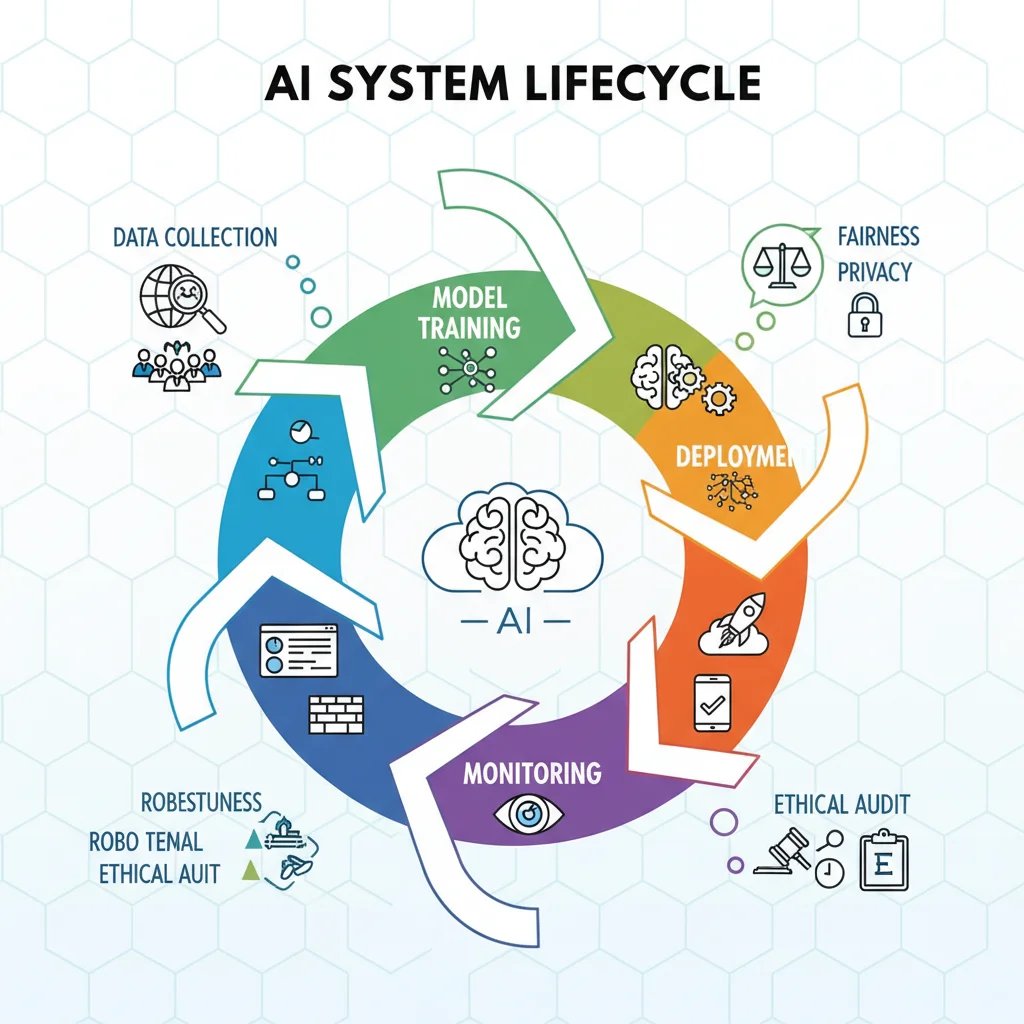
Translate the principles of the chosen frameworks into clear, actionable internal policies and guidelines. These policies should cover the entire AI lifecycle, from data acquisition and model development to deployment, monitoring, and decommissioning. Ensure these policies are easily accessible and understood by all relevant employees.
Step 3: Integrate Ethics into the AI Development Lifecycle (MLOps)
Embed ethical considerations directly into existing MLOps (Machine Learning Operations) pipelines. This means integrating tools for bias detection, fairness metrics, explainability techniques, and security checks at each stage of the AI development process. Ethical considerations should be as fundamental as performance metrics.
Step 4: Invest in Training and Awareness Programs
Educate all employees involved in AI development, deployment, or decision-making on the company’s AI ethics policies and the broader principles of responsible AI. Training should cover topics such as algorithmic bias, data privacy, explainability, and the importance of human oversight. Foster a culture where ethical concerns are encouraged and addressed proactively.
Step 5: Conduct Regular Audits and Impact Assessments
Implement a rigorous schedule for internal and external audits of AI systems. These audits should assess compliance with internal policies, regulatory requirements, and ethical principles. Conduct regular Data Protection Impact Assessments (DPIAs), Privacy Impact Assessments (PIAs), and Social and Environmental Impact Assessments (SEIAs) for all new and existing AI projects.
Step 6: Establish Feedback Mechanisms and Redress Processes
Create clear channels for users, employees, and the public to provide feedback, raise concerns, and seek redress for potential harms caused by AI systems. This demonstrates accountability and provides valuable insights for continuous improvement. Implement transparent processes for investigating and resolving ethical complaints.
Step 7: Stay Informed and Adapt
The field of AI ethics and regulation is dynamic. Continuously monitor developments in U.S. and international AI policy, emerging ethical challenges, and best practices. Be prepared to adapt and evolve your AI Ethics Frameworks as new technologies emerge and societal expectations shift. Engage with industry groups, academic institutions, and regulatory bodies to stay at the forefront of responsible AI.
The Benefits of Proactive AI Ethics Implementation
Adopting robust AI Ethics Frameworks by 2026 offers U.S. companies a multitude of benefits that extend far beyond mere compliance:
- Enhanced Reputation and Brand Value: Companies known for ethical AI practices build stronger brand loyalty, attract top talent, and gain a competitive edge in the market.
- Reduced Legal and Regulatory Risks: Proactive implementation helps companies avoid costly fines, lawsuits, and regulatory penalties associated with non-compliant or unethical AI.
- Improved Product Quality and Trust: Ethically designed AI systems are often more reliable, fair, and user-centric, leading to better products and services that users trust.
- Innovation with Purpose: An ethical foundation encourages responsible innovation, guiding the development of AI solutions that address real-world problems without causing unintended harm.
- Operational Efficiency: Clear ethical guidelines can streamline decision-making processes, reduce rework due to ethical missteps, and foster a more coherent approach to AI development.
- Stronger Stakeholder Relationships: Demonstrating a commitment to ethical AI builds trust with customers, employees, investors, and the wider community.
Conclusion: A Future Built on Trust and Responsibility
The year 2026 marks a crucial inflection point for U.S. companies engaged with Artificial Intelligence. The expectation for ethical AI will no longer be a suggestion but a foundational requirement for doing business. By proactively implementing the five essential AI Ethics Frameworks – the NIST AI Risk Management Framework, Fairness, Accountability, and Transparency (FAT), Data Privacy and Security by Design, Human Oversight and Control, and Social and Environmental Impact Assessment – companies can position themselves for sustained success.
This journey demands a cultural shift, an investment in robust governance, and a continuous commitment to responsible innovation. However, the rewards are substantial: not only will companies ensure compliance with an evolving regulatory landscape, but they will also cultivate public trust, enhance their reputation, and ultimately contribute to a future where AI serves as a powerful force for good. The time to act is now, to build a resilient, ethical, and successful AI future.