
The relentless march of technological progress continues to redefine our world, and nowhere is this more evident than in the realm of wireless communication. We are currently experiencing the transformative power of 5G, yet the whispers of 6G are already growing louder, promising an even more radical overhaul of how we connect, communicate, and innovate. This comprehensive article delves into a detailed 5G 6G comparison, exploring the fundamental differences, projected capabilities, and the profound implications these next-generation wireless technologies will have on US infrastructure by 2026.
Understanding the evolution from 5G to 6G is not merely an academic exercise; it’s a critical foresight into the economic, social, and technological landscape of the near future. As we dissect the nuances of each generation, we will uncover how these advancements will shape industries, drive innovation, and redefine our daily lives. The US, a global leader in technological adoption, stands at the precipice of this new era, and the strategic deployment of 6G will be paramount to maintaining its competitive edge.
The journey from 1G to 5G has been marked by exponential improvements in speed, capacity, and latency. Each generation has introduced new paradigms, from basic voice calls to mobile internet and now, the era of ubiquitous connectivity and the Internet of Things (IoT). The 5G 6G comparison highlights not just an incremental upgrade but a foundational shift in how networks are designed and utilized. By 2026, many of the theoretical concepts of 6G will begin to materialize, impacting everything from smart cities and autonomous systems to advanced healthcare and immersive realities.
The Current Landscape: Understanding 5G’s Capabilities
5G, the fifth generation of cellular technology, has been rolling out globally for several years, bringing with it significant advancements over its predecessors. Its core promises revolve around three main pillars: enhanced Mobile Broadband (eMBB), Ultra-Reliable Low-Latency Communications (URLLC), and Massive Machine-Type Communications (mMTC). These pillars collectively enable a wide array of new applications and services that were previously impossible.
Enhanced Mobile Broadband (eMBB)
eMBB delivers significantly higher speeds and greater capacity than 4G LTE. With peak theoretical speeds up to 10 Gbps and average speeds far exceeding 100 Mbps, 5G allows for faster downloads, seamless streaming of 4K and 8K content, and more efficient cloud computing. This has already begun to transform industries requiring high data throughput, such as media, entertainment, and remote work.
Ultra-Reliable Low-Latency Communications (URLLC)
Perhaps one of 5G’s most revolutionary features is its extremely low latency, which can be as low as 1 millisecond (ms). This near real-time communication is critical for applications demanding instant responses, such as autonomous vehicles, remote surgery, industrial automation, and augmented reality (AR) / virtual reality (VR) experiences. The reliability aspect ensures that these critical communications are delivered without interruption.
Massive Machine-Type Communications (mMTC)
mMTC is designed to connect a vast number of devices simultaneously, making it ideal for the burgeoning IoT ecosystem. 5G can support up to 1 million devices per square kilometer, far exceeding 4G’s capabilities. This enables smart cities to monitor infrastructure, smart homes to automate functions, and industries to deploy vast sensor networks for predictive maintenance and efficiency improvements. The sheer scale of connected devices under 5G is a game-changer for data collection and analysis.
5G’s Impact on US Infrastructure
The deployment of 5G has required substantial investment in new infrastructure, including denser networks of small cells, upgraded fiber optic backbones, and advanced antenna technologies like Massive MIMO (Multiple-Input Multiple-Output). This has stimulated economic growth, created jobs, and laid the groundwork for future technological advancements. However, challenges remain, particularly in achieving ubiquitous coverage and addressing spectrum availability, which will be crucial for any future 5G 6G comparison.
The Emergence of 6G: Beyond the Horizon
While 5G is still being deployed, research and development into 6G are already well underway. 6G is not merely an evolution of 5G; it represents a paradigm shift, pushing the boundaries of wireless communication to unprecedented levels. It aims to address the limitations of 5G and unlock a new era of truly intelligent and immersive connectivity. The projected timeline suggests initial deployments could begin around 2030, but foundational elements and early trials will be visible by 2026, making the 5G 6G comparison increasingly relevant.
Key Characteristics and Potential Capabilities of 6G
6G is envisioned to offer orders of magnitude improvements over 5G in several key areas:
- Extreme Speeds: While 5G offers peak speeds of 10 Gbps, 6G is projected to achieve terabit-per-second (Tbps) speeds, making current 5G speeds seem modest. This will enable instant downloads of entire movies and facilitate ultra-high-definition holographic communication.
- Sub-millisecond Latency: 6G aims for latency in the microsecond range, further enhancing real-time applications and enabling truly seamless human-machine interaction. This will be critical for advanced robotics, real-time AI processing, and tactile internet experiences.
- Ubiquitous Connectivity and Coverage: 6G will extend connectivity to previously underserved areas, including rural regions, and integrate non-terrestrial networks (NTN) such as satellites, high-altitude platform stations (HAPS), and drones to provide truly global coverage.
- AI-Native Network: A defining feature of 6G will be its inherent integration with Artificial Intelligence (AI) and Machine Learning (ML). The network itself will be intelligent, capable of self-optimization, predictive maintenance, and dynamic resource allocation, leading to unprecedented efficiency and reliability.
- Sensing and Imaging Capabilities: Beyond communication, 6G networks are expected to have advanced sensing and imaging capabilities, effectively turning the network into a pervasive sensor. This could enable precise localization, gesture recognition, environmental monitoring, and even non-invasive health monitoring.
- Terahertz (THz) Frequencies: 6G will likely leverage higher frequency bands, including the terahertz (THz) spectrum (100 GHz to 10 THz). These frequencies offer vast bandwidths but also pose significant challenges in terms of signal propagation and hardware development.
- Integrated Communication and Computation: 6G will blur the lines between communication and computation, integrating processing power closer to the edge of the network. This will enable distributed AI and faster data processing for complex applications.
These characteristics paint a picture of a future where the network is not just a conduit for data but an intelligent, sensing, and computing platform that seamlessly integrates the physical and digital worlds.
5G 6G Comparison: A Detailed Analysis
To truly appreciate the leap, a direct 5G 6G comparison is essential. While 5G laid the foundation for a connected world, 6G aims to build an intelligent, immersive, and truly ubiquitous one.
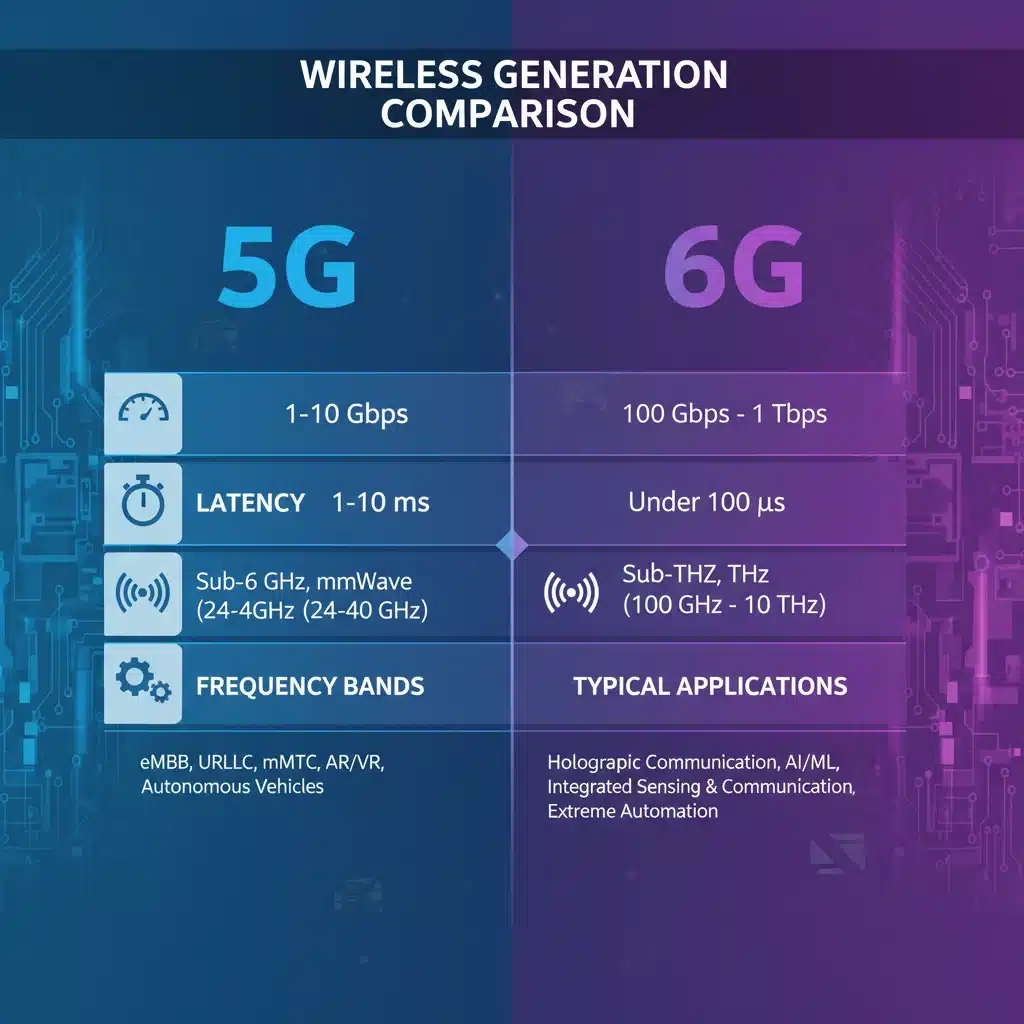
Here’s a breakdown of the key differences:
Speed and Bandwidth
- 5G: Peak speeds up to 10 Gbps, average hundreds of Mbps. Operates across sub-6 GHz and millimeter-wave (mmWave) bands.
- 6G: Projected peak speeds in the Tbps range, average tens to hundreds of Gbps. Will utilize higher frequency bands, including THz spectrum, offering vastly more bandwidth.
Latency
- 5G: Ultra-low latency, typically 1-5 ms. Critical for URLLC applications.
- 6G: Extremely low latency, aiming for sub-1 ms (microseconds). Essential for real-time AI, holographic communication, and tactile internet.
Connectivity Density
- 5G: Supports up to 1 million devices/km². Ideal for current IoT deployments.
- 6G: Expected to support significantly higher densities, potentially tens of millions of devices/km², enabling truly massive IoT and pervasive sensing.
Frequency Spectrum
- 5G: Primarily sub-6 GHz and mmWave (24-47 GHz).
- 6G: Extends into the THz range (100 GHz to 10 THz), alongside continued use of lower bands.
Core Technologies
- 5G: Massive MIMO, beamforming, network slicing, SDN/NFV.
- 6G: AI/ML integration, reconfigurable intelligent surfaces (RIS), integrated sensing and communication (ISAC), holographic radio, blockchain for security, quantum computing integration.
Applications
- 5G: Enhanced mobile broadband, IoT, autonomous vehicles (basic), AR/VR, smart factories.
- 6G: Holographic communication, tactile internet, intelligent autonomous systems (fully), pervasive AI, digital twins, real-time brain-computer interfaces, advanced healthcare (remote surgery with haptic feedback), space-terrestrial integrated networks.
Intelligence
- 5G: Network management can be AI-assisted.
- 6G: AI-native network, self-optimizing, self-healing, and deeply integrated with AI at all layers.
The 5G 6G comparison clearly shows that 6G is not just about faster speeds, but about creating an intelligent, sensing, and truly immersive digital environment that is deeply integrated with the physical world. It’s about moving from connected ‘things’ to connected ‘intelligence’.
Impact on US Infrastructure by 2026
The timeline for 6G deployment suggests that by 2026, we will be in a crucial preparatory phase. While widespread commercial 6G might be a few years further out, significant investments, research, and pilot programs will be actively shaping US infrastructure. The 5G 6G comparison becomes vital in understanding these preparatory steps.
Continued 5G Expansion and Optimization
Before 6G takes center stage, 5G deployment will continue to expand, especially in rural and underserved areas. Infrastructure will be optimized for greater efficiency and reliability. The lessons learned from 5G rollout – regarding spectrum allocation, small cell deployment, and fiber backhaul – will directly inform the strategies for 6G.
Research and Development Investment
The US government, academic institutions, and private sector companies will significantly ramp up R&D into 6G. This includes funding for universities, establishing research consortiums, and developing testbeds for new technologies like THz communication, AI-driven network management, and quantum-resistant cryptography. This investment will drive innovation in hardware, software, and network architectures.
Spectrum Planning and Allocation
Identifying and allocating new spectrum bands, particularly in the THz range, will be a critical challenge. Regulatory bodies like the FCC will need to develop frameworks for spectrum sharing and licensing that foster innovation while ensuring fair competition. This process is complex and often takes years, making 2026 a key period for foundational decisions.
Fiber Optic Backbone Enhancement
The demands of 6G, with its ultra-high speeds and massive data volumes, will necessitate an even more robust and extensive fiber optic backbone. Existing fiber infrastructure will need significant upgrades and expansion to handle the immense data traffic generated by 6G networks. This will be a major infrastructure project across the US.
Edge Computing Infrastructure Development
6G’s vision of integrated communication and computation will accelerate the development of edge computing infrastructure. Data centers and processing capabilities will move closer to the end-users and devices, reducing latency and enabling real-time AI processing. This will require new investments in localized data centers and distributed computing resources.
Talent Development and Workforce Training
The complex nature of 6G will demand a highly skilled workforce. By 2026, there will be an increased focus on training engineers, data scientists, and technicians in areas like AI/ML, THz technology, quantum communications, and cybersecurity to manage and develop 6G networks. Educational institutions will need to adapt their curricula to meet these future demands.
Security and Resilience
With greater connectivity comes greater vulnerability. 6G networks will be designed with security and resilience as core tenets, integrating advanced cryptographic methods, potentially including quantum-resistant algorithms, and robust cybersecurity protocols from the ground up. Infrastructure will need to be hardened against both cyber and physical threats.
Transformative Applications Enabled by 6G in the US
The true power of 6G lies in the applications it will enable, many of which are currently in their nascent stages or entirely theoretical. The 5G 6G comparison reveals a future where technology is not just an tool, but an extension of our senses and intelligence.
Holographic Communication and Immersive Experiences
Imagine communicating with lifelike 3D holograms of distant colleagues or attending virtual concerts with a true sense of presence. 6G’s ultra-high bandwidth and low latency will make holographic communication and truly immersive AR/VR/XR (Extended Reality) experiences a reality, transforming remote work, education, and entertainment.
Tactile Internet and Remote Control
The tactile internet, enabled by microsecond latency, will allow for real-time haptic feedback and remote control of physical objects with precision. This has profound implications for remote surgery, complex industrial operations, and even new forms of entertainment where users can ‘feel’ digital objects.
Intelligent Autonomous Systems
Autonomous vehicles will evolve into fully intelligent systems, capable of real-time collaboration with other vehicles and infrastructure. Drones will perform complex tasks in swarms, and robotics will become more pervasive and autonomous in manufacturing, logistics, and service industries. The network will be their collective brain.
Digital Twins and Smart Environments
6G will facilitate the creation of highly detailed ‘digital twins‘ of physical environments, from entire cities to individual factories. These digital replicas, constantly updated with real-time data from 6G sensors, will allow for predictive modeling, optimization, and simulation, leading to unprecedented efficiency and resource management in smart cities and industries.
Pervasive AI and Machine-to-Machine Intelligence
With an AI-native network, artificial intelligence will be distributed throughout the infrastructure, enabling devices to communicate and make intelligent decisions autonomously. This will lead to truly smart environments that anticipate needs, optimize resources, and provide proactive services without human intervention.
Advanced Healthcare and Wellness
6G will revolutionize healthcare through real-time remote diagnostics, AI-powered predictive health monitoring, and even remote surgical procedures with haptic feedback. Wearable devices will become more sophisticated, continuously monitoring vital signs and providing personalized health insights, seamlessly connected by the pervasive 6G network.

These applications highlight the profound shift from merely connecting devices to creating an intelligent, responsive, and deeply integrated digital-physical ecosystem. The 5G 6G comparison underscores this evolution from a high-speed pipe to an intelligent platform.
Challenges and Considerations for 6G Deployment in the US
While the promise of 6G is immense, its realization will face significant challenges that the US must address strategically.
Technological Hurdles
Developing viable THz components, overcoming signal propagation issues at these frequencies, and integrating new technologies like RIS and quantum computing are massive engineering feats. The miniaturization and energy efficiency of 6G hardware will also be critical.
Standardization and Interoperability
Establishing global standards for 6G will be crucial for seamless international connectivity and avoiding fragmentation. The US will need to play a leading role in these international forums to ensure its interests are represented and to foster innovation.
Security and Privacy
The increased attack surface and the pervasive sensing capabilities of 6G raise significant concerns about cybersecurity and individual privacy. Robust security protocols, privacy-by-design principles, and regulatory frameworks will be essential to build trust and prevent misuse of data.
Economic Viability and Investment
The sheer cost of deploying 6G infrastructure will be astronomical. Governments and private companies will need to collaborate on funding models, incentives, and regulatory environments that encourage investment and ensure a return. The business case for many 6G applications is still evolving.
Digital Divide
Ensuring equitable access to 6G technologies will be paramount to prevent exacerbating the digital divide. Strategies must be in place to bring advanced connectivity to rural and underserved communities, avoiding a two-tiered society where some have access to cutting-edge technology and others are left behind.
Energy Consumption
The increasing density and complexity of 6G networks could lead to higher energy consumption. Research into energy-efficient network designs, sustainable power sources, and optimized resource management will be critical to minimize the environmental footprint.
Conclusion: The Road Ahead for US Wireless Infrastructure
The 5G 6G comparison reveals a future where wireless technology transcends mere communication, becoming an intelligent, omnipresent fabric that deeply integrates our physical and digital realities. By 2026, the United States will be well into the foundational stages of 6G, with significant investments in research, infrastructure upgrades, and spectrum planning. While 5G continues its vital role in connecting our present, the groundwork for 6G will lay the foundation for a future of unprecedented connectivity, intelligence, and immersive experiences.
The journey to 6G is not without its hurdles, but the potential rewards – from economic growth and industrial transformation to enhanced quality of life and global leadership in technology – are immense. Strategic foresight, collaborative efforts between government and industry, and a commitment to innovation will be crucial for the US to successfully navigate this next frontier of wireless technology. The world of 2026 will be a testament to the initial steps taken today towards a 6G-powered tomorrow.