Criminal Justice Reform: Saving US Taxpayers Billions Annually
The Staggering Cost of Incarceration: How Criminal Justice Reform Could Save US Taxpayers $80 Billion Annually
The United States boasts the highest incarceration rate in the world, a fact that carries profound social and economic implications. Beyond the moral and ethical debates surrounding mass incarceration, there’s a significant financial burden borne by American taxpayers. The cost of maintaining our extensive correctional system is astronomical, diverting billions of dollars annually from other critical public services. However, a growing body of evidence suggests that comprehensive criminal justice savings through reform could not only reduce crime but also save US taxpayers an astounding $80 billion each year. This article delves into the financial intricacies of mass incarceration, explores the potential for substantial savings through reform, and examines the broader societal benefits of a more just and effective system.
Understanding the Financial Drain: The True Cost of Incarceration
The notion that incarceration is a cost-effective solution to crime is a persistent myth. In reality, the financial outlay for housing, feeding, and providing medical care for millions of inmates is staggering. Various studies and reports from organizations like the Vera Institute of Justice consistently highlight the escalating expenses. These costs are not merely confined to the direct expenses of prison operations; they extend to a complex web of indirect costs that ripple through communities and the national economy.
Direct Costs: The Bill for Running Prisons
The most immediate and obvious costs are the direct operational expenses of correctional facilities. These include:
- Housing and Maintenance: The daily cost of housing an inmate, which varies significantly by state, encompasses everything from utilities and facility upkeep to security infrastructure.
- Staff Salaries and Benefits: A substantial portion of correctional budgets goes towards the salaries, benefits, and training of correctional officers, administrative staff, and other personnel.
- Food Services: Providing meals for millions of individuals daily is a massive logistical and financial undertaking.
- Healthcare: Inmates have a constitutional right to healthcare, and the provision of medical, dental, and mental health services in correctional settings is a significant and often rising expense, especially given the aging inmate population and the prevalence of chronic health conditions and mental illness within incarcerated populations.
- Education and Vocational Programs: While often underfunded, some resources are allocated to educational and vocational training programs aimed at rehabilitation and reducing recidivism.
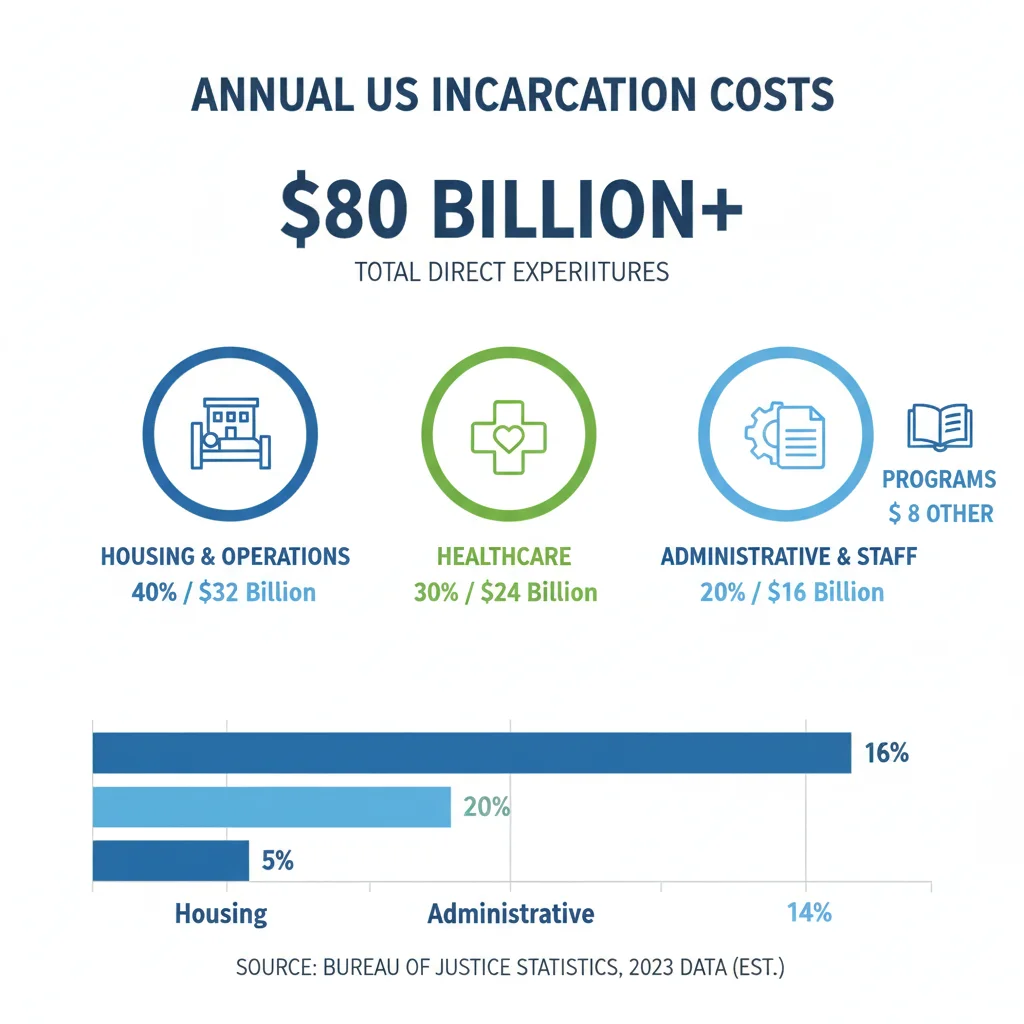
When aggregated across federal, state, and local correctional systems, these direct costs alone amount to tens of billions of dollars annually. For instance, some estimates place the annual cost per inmate at upwards of $30,000, and in some states, it can exceed $60,000. With over 2 million people incarcerated in the US, the numbers quickly become astronomical.
Indirect Costs: The Hidden Financial Burden
Beyond the direct operational costs, mass incarceration imposes a multitude of indirect financial burdens that are often overlooked but equally impactful:
- Lost Economic Productivity: When individuals are incarcerated, they are removed from the workforce, leading to a loss of potential earnings, tax contributions, and consumer spending. This loss extends to their families, who may struggle financially in their absence.
- Family Support Costs: Families of incarcerated individuals often face significant financial strain, including legal fees, travel expenses for visits, and the loss of a primary or secondary income earner. This can push families into poverty and increase reliance on public assistance programs.
- Social Welfare Costs: Children of incarcerated parents are more likely to experience poverty, educational difficulties, and behavioral problems, often requiring increased social services and support from the state.
- Public Safety Costs: High recidivism rates mean that individuals often re-enter the system, incurring repeated costs for arrest, prosecution, and re-incarceration. Effective rehabilitation and reintegration programs, while an upfront investment, can significantly reduce these cyclical costs.
- Community Disinvestment: Resources allocated to mass incarceration could otherwise be invested in education, infrastructure, healthcare, and other community development initiatives that foster economic growth and reduce crime more effectively in the long run.
These direct and indirect costs collectively paint a stark picture of a system that is not only failing to adequately address the root causes of crime but is also a massive drain on public resources. The potential for criminal justice savings by re-evaluating our approach is immense.
The $80 Billion Opportunity: Where Savings Can Be Found
The figure of $80 billion in potential annual savings is not an arbitrary number. It’s derived from various analyses that consider the combined impact of reducing incarceration rates, implementing effective alternatives to incarceration, and investing in evidence-based rehabilitation and reentry programs. Achieving these criminal justice savings requires a multi-faceted approach that targets different stages of the justice system.
1. Decriminalization and Diversion Programs
Many individuals are incarcerated for non-violent offenses, often related to drug possession, mental health issues, or minor property crimes. Decriminalizing certain offenses and diverting individuals to treatment programs, community service, or restorative justice initiatives can significantly reduce the number of people entering the correctional system. This not only saves on arrest, prosecution, and incarceration costs but also addresses the underlying issues that contribute to these behaviors.
- Drug Courts and Treatment: Instead of incarceration, directing individuals with substance abuse issues to drug courts and comprehensive treatment programs has proven to be more effective in reducing recidivism and is significantly less expensive than prison stays.
- Mental Health Diversion: For individuals with mental health conditions, diverting them to community-based mental health services can prevent unnecessary incarceration and provide more appropriate care.
- Pre-Trial Diversion: Offering diversion programs for certain first-time, non-violent offenders can prevent them from acquiring a criminal record, which often creates lifelong barriers to employment and housing, further perpetuating the cycle of crime.
2. Sentencing Reform
Mandatory minimum sentences and harsh sentencing guidelines have contributed to the ballooning prison population. Reforming these policies to allow for greater judicial discretion, focusing on proportionality, and reserving incarceration for serious and violent offenses can lead to a significant reduction in the number of people in prison and the length of their stays.
- Reducing Mandatory Minimums: Revisiting and repealing mandatory minimum sentences for non-violent offenses can allow judges to impose sentences that are more appropriate to the crime and the individual, often leading to shorter sentences or alternatives to incarceration.
- Reclassifying Offenses: Reclassifying certain low-level felonies as misdemeanors can reduce the severity of penalties and open doors to diversion programs.
- Retroactive Application of Reforms: Applying new, less punitive sentencing guidelines retroactively can lead to the release of individuals who have already served lengthy sentences for offenses that would now carry lighter penalties.
3. Investing in Rehabilitation and Reentry Programs
The goal of the justice system should not merely be punishment but also rehabilitation and successful reintegration into society. Investing in effective programs within correctional facilities and upon release can drastically reduce recidivism rates, thereby generating substantial long-term criminal justice savings.
- Education and Vocational Training: Providing inmates with marketable skills and educational opportunities significantly increases their chances of securing employment upon release, reducing the likelihood of re-offending.
- Therapeutic Programs: Addressing trauma, anger management, and other behavioral issues through therapy and counseling can equip individuals with coping mechanisms and reduce aggressive behaviors.
- Housing and Employment Support: Ensuring access to stable housing and employment upon release is critical. Programs that connect ex-offenders with job opportunities, housing assistance, and mentorship can dramatically improve their chances of successful reentry.
- Mental Health and Substance Abuse Treatment: Continuing treatment for mental health and substance abuse issues post-release is crucial for preventing relapse and re-offending.
4. Reforming Bail Systems
The current cash bail system disproportionately impacts low-income individuals, leading to pre-trial detention for those who cannot afford bail, even for minor offenses. This not only violates principles of fairness but also incurs significant costs for housing individuals who have not yet been convicted of a crime. Bail reform, such as implementing risk-assessment tools and pre-trial release programs, can save millions by reducing unnecessary pre-trial incarceration.
Beyond the Dollars: Societal Impact of Reform
While the financial savings are compelling, the benefits of criminal justice reform extend far beyond monetary considerations. A more just and effective system has profound positive societal impacts:
Strengthening Communities
Mass incarceration destabilizes communities by removing parents, workers, and community members. Reform can help rebuild these social fabrics by keeping families together, fostering local economic development, and empowering individuals to contribute positively to their neighborhoods.
Reducing Recidivism and Enhancing Public Safety
Evidence-based reforms that focus on rehabilitation, education, and successful reentry lead to lower recidivism rates. When individuals are equipped with the tools to lead productive lives post-incarceration, they are less likely to re-offend, making communities safer in the long run. This is a crucial aspect of realizing true criminal justice savings.
Promoting Racial and Social Equity
The US criminal justice system disproportionately impacts minority communities. Reform efforts can address these systemic inequalities, leading to a more equitable application of justice and reducing the racial disparities in incarceration rates.
Reinvesting in Human Capital
The $80 billion saved annually could be reinvested into vital public services and programs. Imagine redirecting these funds to:
- Education: Improving public schools, increasing teacher salaries, and expanding access to higher education.
- Healthcare: Expanding access to affordable healthcare, particularly mental health and substance abuse services.
- Infrastructure: Repairing roads, bridges, and public transportation.
- Community Development: Funding job creation programs, affordable housing initiatives, and youth development programs in underserved areas.
This reinvestment represents a shift from a punitive approach to a preventative one, addressing the root causes of crime rather than simply reacting to its symptoms.

Challenges and the Path Forward
Implementing comprehensive criminal justice reform is not without its challenges. Political will, public perception, and entrenched interests within the correctional industry can pose significant hurdles. However, the growing bipartisan support for reform, driven by both fiscal conservatism and social justice concerns, indicates a promising path forward.
Overcoming Resistance
One of the primary challenges is overcoming resistance from those who believe that ‘tough on crime’ policies are the only effective way to ensure public safety. Educating the public about the true costs and ineffectiveness of mass incarceration, and highlighting the success stories of reform initiatives, is crucial.
Data-Driven Decisions
Successful reform requires a commitment to data-driven decision-making. States and localities must collect and analyze data on crime rates, recidivism, and the effectiveness of various programs to identify what works and where resources are best allocated. This data is essential for demonstrating the tangible criminal justice savings and societal benefits of reform.
Collaboration Across Sectors
Effective reform requires collaboration among various stakeholders, including law enforcement, prosecutors, judges, defense attorneys, community organizations, mental health professionals, and policymakers. A holistic approach that addresses the entire justice ecosystem is necessary for sustainable change.
Long-Term Vision
The benefits of criminal justice reform, particularly in terms of reduced recidivism and enhanced public safety, often manifest over the long term. Policymakers must adopt a long-term vision, understanding that upfront investments in prevention, rehabilitation, and reentry programs will yield significant returns down the road, both financially and societally.
Case Studies: States Leading the Way in Criminal Justice Savings
Several states have already embarked on significant criminal justice reform efforts, demonstrating tangible results in both reducing incarceration rates and achieving substantial savings. These examples serve as powerful models for other jurisdictions considering similar changes.
Texas: A Pioneer in Smart Justice
Texas, historically known for its tough-on-crime stance, began implementing significant reforms in the mid-2000s when facing a projected need for 17,000 new prison beds. Instead of building more prisons, the state invested in treatment and diversion programs, as well as probation and parole services. The results were remarkable: the state closed prisons, saved billions of dollars, and saw a decrease in its crime rate. This shift demonstrated that investing in alternatives to incarceration could lead to both fiscal responsibility and improved public safety, proving that significant criminal justice savings are attainable.
California: Realigning Public Safety
California’s Public Safety Realignment Act of 2011 was a monumental shift that moved responsibility for supervising non-serious, non-violent, non-sex offenders from state prisons to county jails and probation departments. While initially facing challenges, the realignment has led to a significant decrease in the state prison population and spurred counties to develop more localized, community-based solutions for managing offenders. This has fostered innovation in rehabilitation and reentry programs, with a long-term goal of increasing public safety while optimizing resource allocation.
Georgia: Second Chance Reforms
Georgia has implemented a series of ‘second chance’ reforms aimed at reducing recidivism and strengthening communities. These reforms include expanding drug courts, mental health courts, and veterans courts, as well as reforming felony sentencing laws. By focusing on rehabilitation and providing pathways for successful reentry, Georgia has seen its prison population stabilize and has avoided the need for costly new prison construction, showcasing another successful model for achieving criminal justice savings.
New Jersey: Bail Reform Success
New Jersey enacted comprehensive bail reform in 2017, largely eliminating money bail and replacing it with a risk-assessment system to determine pre-trial release. This reform significantly reduced the number of people held in jail awaiting trial, particularly those who were low-risk but couldn’t afford bail. The state has seen its pre-trial jail population drop dramatically, leading to substantial savings in incarceration costs while maintaining or even improving public safety, further solidifying the potential for criminal justice savings through targeted reforms.
These case studies underscore a critical point: criminal justice reform is not merely an abstract ideal but a practical, evidence-based approach that delivers tangible financial and societal benefits. The experiences of these states provide a blueprint for how the US can move towards a more effective, equitable, and fiscally responsible justice system.
Conclusion: A Call for Smart Justice and Substantial Savings
The current state of mass incarceration in the United States is unsustainable, both financially and morally. The cost to taxpayers is immense, diverting crucial resources that could otherwise be invested in building stronger, healthier communities. The potential to save $80 billion annually through comprehensive criminal justice reform is a compelling argument that transcends political divides.
By embracing strategies such as decriminalization, diversion programs, sentencing reform, and robust investments in rehabilitation and reentry, the US can transition from a system focused primarily on punishment to one that prioritizes public safety, rehabilitation, and fiscal responsibility. These reforms are not just about saving money; they are about fostering a society where justice is applied equitably, individuals have opportunities for redemption, and communities thrive. The time for smart justice and substantial criminal justice savings is now.